Cause & Consequence
- Collapse, overturn or failure of lifting equipment
Description of Incident
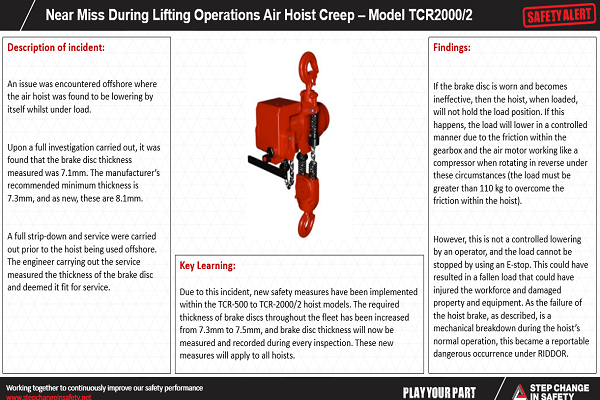
An issue was encountered offshore where the air hoist was found to be lowering by itself whilst under load.
Upon a full investigation carried out, it was found that the brake disc thickness measured was 7.1mm. The manufacturer’s recommended minimum thickness is 7.3mm, and as new, these are 8.1mm.
A full strip-down and service were carried out prior to the hoist being used offshore. The engineer carrying out the service measured the thickness of the brake disc and deemed it fit for service.
Findings
If the brake disc is worn and becomes ineffective, then the hoist, when loaded, will not hold the load position. If this happens, the load will lower in a controlled manner due to the friction within the gearbox and the air motor working like a compressor when rotating in reverse under these circumstances (the load must be greater than 110 kg to overcome the friction within the hoist).
However, this is not a controlled lowering by an operator, and the load cannot be stopped by using an E-stop. This could have resulted in a fallen load that could have injured the workforce and damaged property and equipment. As the failure of the hoist brake, as described, is a mechanical breakdown during the hoist’s normal operation, this became a reportable dangerous occurrence under RIDDOR.
Key Learning
Due to this incident, new safety measures have been implemented within the TCR-500 to TCR-2000/2 hoist models. The required thickness of brake discs throughout the fleet has been increased from 7.3mm to 7.5mm, and brake disc thickness will now be measured and recorded during every inspection. These new measures will apply to all hoists.
Rate this alert
Average Rating
Latest Alerts & Moments
Our searchable catalogue of hundreds of Safety Alerts and Safety Moments are all designed as learning resources that can help improve workplace safety.